
You pick up your phone to check a notification. Twenty minutes later, you’re watching a video about organizing a kitchen you don’t own, and you’ve completely forgotten why you picked up your phone in the first place.
Sound familiar?
Our phones make it incredibly easy to fill a moment. Waiting for coffee? Scroll. Sitting on the couch? Scroll. Trying to relax before bed? Somehow, more scrolling.
There’s nothing wrong with enjoying technology. But when checking our phones becomes automatic, even habitual, we sometimes spend more time online than intended.
Digital detox journaling helps by offering a simple way to become more aware of those habits and make room for more meaningful activities.
In this guide, I’ll explain how digital detox journaling works, share ten helpful journal prompts, and show you a simple 10-minute routine you can try today.
Key Takeaways
- Digital detox journaling combines screen-free time with reflective writing to help you notice some of your technology habits.
- Explore when you reach for your phone, what you’re looking for, and how you feel afterward.
- Start with five to ten minutes, one journal prompt, and one realistic change, such as having your first coffee before checking social media.
- The goal is more intentional screen use and having room for the people and activities that matter to you.
What Is Digital Detox Journaling?
Digital detox journaling combines intentional breaks from screens with reflective writing.
Instead of focusing entirely on dropping your screen-time, you use a journal to explore when you reach for your devices, what triggers those habits, and how you feel afterward.
For example, you might notice that you scroll whenever you’re bored or avoiding a difficult task.
Or you might find out checking social media before bed leaves you feeling more ampped up when you’re trying to wind down.
Your journal gives you a place to see these patterns without criticizing yourself.
And unlike an all-out digital detox, you can start with just a few minutes each day.
The goal isn’t to get rid of technology. It’s to make your screen time a choice rather than an automatic response.
Why Do We Keep Reaching for Our Phones?
Have you ever opened an app without remembering why?
Sometimes we reach for our phones because we’re looking for some information or want to connect with someone. Other times, checking them becomes part of our everyday routine.
Think about some common situations:
- You’re bored while waiting for an appointment.
- You’re overwhelmed with work and looking for a distraction.
- You’re tired but keep watching videos instead of going to bed.
- You’re avoiding a task that feels uncomfortable.
- You hear a notification and immediately stop what you’re doing to check.
These habits aren’t necessarily signs of a serious problem. But they can make it harder to give our full attention to other activities.
That’s where journaling becomes useful.
Rather than simply asking, “How can I spend less time on my phone?” try asking:
“What am I looking for when I reach for my phone?”
Maybe it’s just for fun, making a connection, finding reassurance, or just a break from something stressful.
Understanding the reason why can help you question whether scrolling is doing as intended.
Can Digital Detox Journaling Really Help?
Research on reducing social media use has come up mixed results.
A 2018 study published in the Journal of Social and Clinical Psychology found that college students who limited their social media use to approximately 30 minutes per day experienced reductions in loneliness and depressive symptoms compared with a control group.
However, other research has found that completely avoiding social media doesn’t regularly improve well-being.
This suggests that how we use technology may matter just as much as how much we use it.
Reflective writing should also be mentioned. A 2006 meta-analysis in Psychological Bulletin found that expressive writing produced modest benefits across a range of outcomes.
That doesn’t mean digital detox journaling itself has been proven to treat anxiety, depression, or excessive screen use.
But that doesn’t meanjournaling can’t be used in a practical way to look closely at your habits and experiment with more intentional choices.
How to Start Digital Detox Journaling
You don’t need an intricate and elaborate set of plans. A notebook, a pen, and a few uninterrupted minutes are enough.
Here are five steps to get started.
1. Choose One Screen-Free Moment
Pick a time when you’re normally scrolling.
It could be the first ten minutes after waking up, your lunch break, or the few minutes before bed.
Try starting with just one part of your day rather than trying to change everything at once.
2. Put Your Phone Out of Reach
Place your phone in another room, silence unnecessary notifications, or even just keep it out of sight.
If you need to remain available for work or family, adjust your settings so important calls can still come through.
You can reduce the friction and still be reachable.
3. Notice How You’re Feeling
Before writing, pause and ask yourself:
“What am I feeling right now?”
Maybe you’re bored, restless, tired, or perfectly content.
There’s no right or wrong answer.
You’re just becoming more aware of what’s happening before turning to a screen.
4. Write for Five Minutes
Start by describing your current thoughts or feelings.
You might write:
“I wanted to check my phone because I’m avoiding a project I don’t feel like finishing.”
Or:
“I keep reaching for my phone when the house gets quiet. I’m not sure why.”
Don’t worry about punctuation sentence structure or coming up with profound insights.
If you’re new to writing regularly, my guide to journaling for beginners offers additional help getting started.
5. End With One Small Intention
Before closing your journal, choose one realistic change.
For example:
“Tomorrow, I’ll drink my morning coffee before checking social media.”
Or:
“When I feel bored this afternoon, I’ll take a short walk before opening an app.”
Small changes are easier to work into everyday life than an all-or-nothing digital detox.

10 Digital Detox Journal Prompts to Help You Unplug
If you’re not sure what to write, these prompts can help you explore your relationship with technology.
You don’t have to answer them all at once. Choose one or two that feel relevant.
- When do I reach for my phone without thinking?
- Which apps leave me feeling energized, and which leave me feeling drained?
- What emotions do I experience before I start scrolling?
- What am I hoping to find when I check my phone?
- How do I feel after spending more time online than I intended?
- What activities do I enjoy that don’t involve a screen?
- When was the last time I felt completely present? What was I doing?
- What thoughts or feelings appear when I sit quietly without distractions?
- What is one realistic boundary I could set around my screen use?
- What would a healthier relationship with technology look like for me?
I particularly like prompts three and four because they shift the focus away from screen-time numbers and toward understanding why we use our devices.
And if your answer is simply, “I was bored and wanted to watch something funny,” I get it, been there.
The purpose isn’t to make every minute productive. It’s to simply understand your choices.
Try This 10-Minute Screen-Free Journaling Routine
One of the easiest ways to start is to substitute a short scrolling session with a little quiet reflection.
Here’s a routine you can try at home.
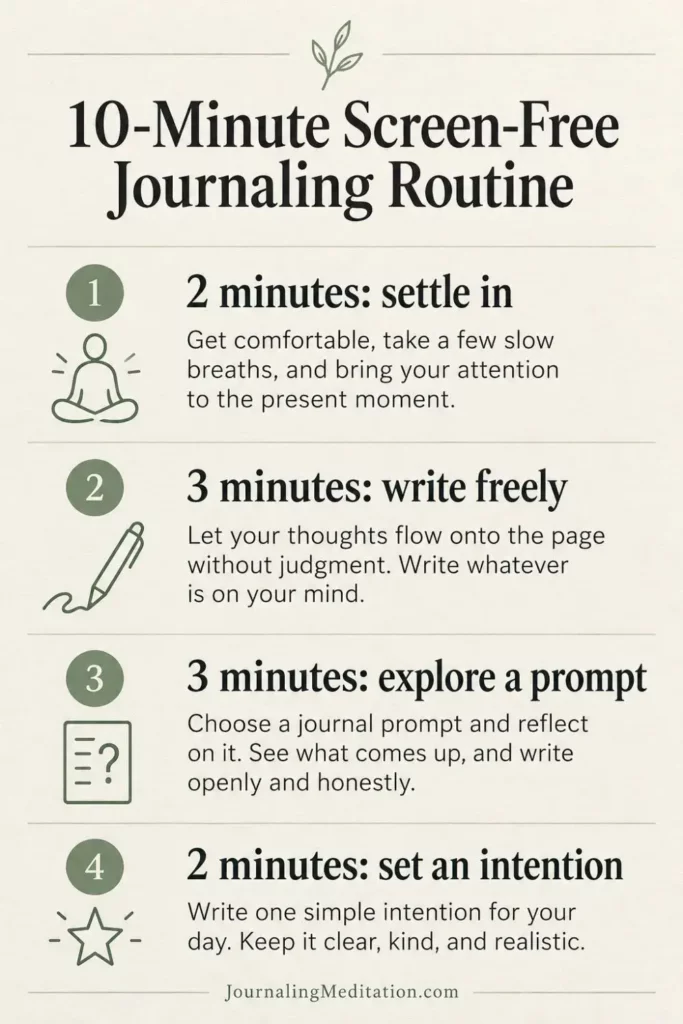
That’s it.
You don’t need a perfect meditation space or an elaborate morning routine.
You can do this at your kitchen table, beside your bed, or in a quiet corner of your home.
If you enjoy combining journaling with mindful breathing, my Meditation for Beginners guide offers simple ways to begin a meditation practice.
And if you’d like a more consistent place for quiet reflection, you can explore my guide to creating a meditation space at home.
What If You Keep Reaching for Your Phone?
Changing a familiar habit isn’t easy.
If you’re scrolling again after deciding to take a break, don’t turn it into another reason to criticize yourself.
Instead, try making your screen-free routine easier.
Start smaller. If ten minutes feels difficult, begin with five. Or even three.
Keep your journal visible. Leave it somewhere you’ll see it, like the kitchen table or next to your favorite chair.
Choose a specific time. Journaling after morning coffee may be easier to remember than vaguely promising to write sometime during the day. Journaling before bed allows for reflection on the day.
Try a different activity. If writing isn’t what you need at that moment, maybe read, stretch, take a walk, or just simply resting.
And if journaling causes you to replay the same stressful thoughts repeatedly, try using a structured prompt or ending your entry with one practical next step.
My guide to keeping a journal for mental health explores additional ways to use writing for emotional awareness and reflection.
Remember, the purpose of digital detox journaling isn’t to create another rule you feel guilty about breaking.
It’s to build a more intentional relationship with your time and attention.
Digital Detox Journaling FAQs
Do I Need a Paper Journal for a Digital Detox?
A paper journal is helpful because it removes the possibility of digital notifications getting in the way of your writing.
However, you can still practice intentional journaling on a device if you can turn off notifications and not switch between apps.
How Long Should I Journal Each Day?
Five to ten minutes is a reasonable starting point.
There’s no universal amount of journaling that guarantees results. Choose a length that feels manageable, useful and one that’s not intimidating..
Can I Still Use Social Media During a Digital Detox?
Absolutely.
A digital detox doesn’t have to mean giving up social media completely.
You might decide to stop scrolling before bed, turn off unnecessary notifications, or schedule a short screen-free break each day.
The goal is intentional use, not eliminating every digital activity.
Final Thoughts: Make More Room for What Matters
I don’t think our phones need to be the enemy.
Technology helps us stay connected, learn new things, and enjoy activities that make everyday life easier.
But when every quiet moment turns into another opportunity to scroll, we can lose track of how we’re spending our attention.
Digital detox journaling offers a simple way to change that.
You don’t need to overhaul your entire routine.
Start with ten minutes. Put your phone aside. Open your journal. Notice what’s on your mind.
And ask yourself:
“What would I like to give more of my attention to today?”
Sometimes a few quiet minutes are enough to remind us that there’s more to our day than the next notification.
I’d love to hear from you: When do you find yourself scrolling the most? First thing in the morning, during breaks, or before bed? Have you tried replacing that time with journaling or meditation?
Share your experience in the comments. Your ideas might help someone else find a screen-free routine that works for them. And thanks for reading!