
Updated 4/26
If you’ve ever opened a blank notebook, stared at the page, and thought “cool… now what?”… you’re not alone. That exact moment is why a journal with prompts has started to become one of the most effective (and beginner-friendly) ways to build a consistent journaling habit.
In a world where our attention is constantly pulled in 10 different directions, prompts act like mental maps. They keep you from staring at a blank page, guide your thinking, and help you actually start, which is usually the hardest part.

I’ve personally found that using prompts can turn journaling from a “maybe I’ll get to it” habit into something I can actually stick with. And once it sticks, that’s when the real benefits kick in.
Some of the links in this post are affiliate links through Bookshop.org, which supports independent bookstores. If you choose to purchase through them, I may earn a small commission at no extra cost to you.
TL;DR (Key Takeaways)
- A journal with prompts removes the guesswork from journaling
- Prompts improve consistency by lowering mental resistance
- Backed by research on expressive writing and emotional processing
- Works for beginners and experienced journalers
- You don’t need more time. You just need a better starting point
Recommended Prompt Journals (If You Want a Head Start)
Here are a few types I recommend depending on your style:
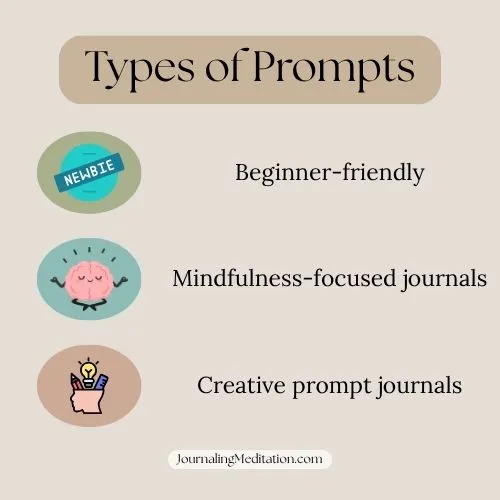
- Beginner-friendly guided journals – Simple prompts, low pressure
- Mindfulness-focused journals – Perfect for pairing with journaling with meditation
- Creative prompt journals – Ideal if you want to spark ideas and explore self-expression
👉 Browse prompt journals on Bookshop.org
Why Prompt Journaling Still Matters in 2026
Let’s be real. Our brains are overloaded. Between our phones, AI tools, and constant content, we rarely sit with our own thoughts anymore.
That’s where a journal with prompts comes in. It’s not just about writing. It’s about guided thinking. Prompts help you slow down, reflect, and actually process what’s going.
There’s also science to back this up. Research from James W. Pennebaker shows that expressive writing can improve emotional regulation, reduce stress, and even support immune function.
So no, journaling isn’t just a trendy habit. It’s a proven tool that helps with mental clarity.
What Is a Journal With Prompts?
A journal with prompts is simply a journaling practice where you respond to guided questions or statements instead of writing freely from scratch.
Think of prompts as:
- A starting point
- A thought trigger
- A way to bypass overthinking

If you’re still learning the basics, my Journaling for Beginners guide explains how to start journaling, what to write, and the different approaches you can experiment with before deciding what works for you.
Types of Journal Prompts
Not all prompts are created equal. And that’s a good thing.
- Self-reflection prompts → “What patterns keep showing up in my life?”
- Emotional processing prompts → “What am I avoiding feeling right now?”
- Goal-oriented prompts → “What does success look like this month?”
- Creative prompts → “Describe your ideal day in vivid detail”
- Mindfulness prompts → “What did I notice about today that I usually miss?”
The variety is what keeps this practice fresh instead of feeling like a chore.
How to Use a Journal With Prompts (Without Overthinking It)
You don’t need a complicated system. In fact, simpler is better.
The 5-Minute Prompt Method
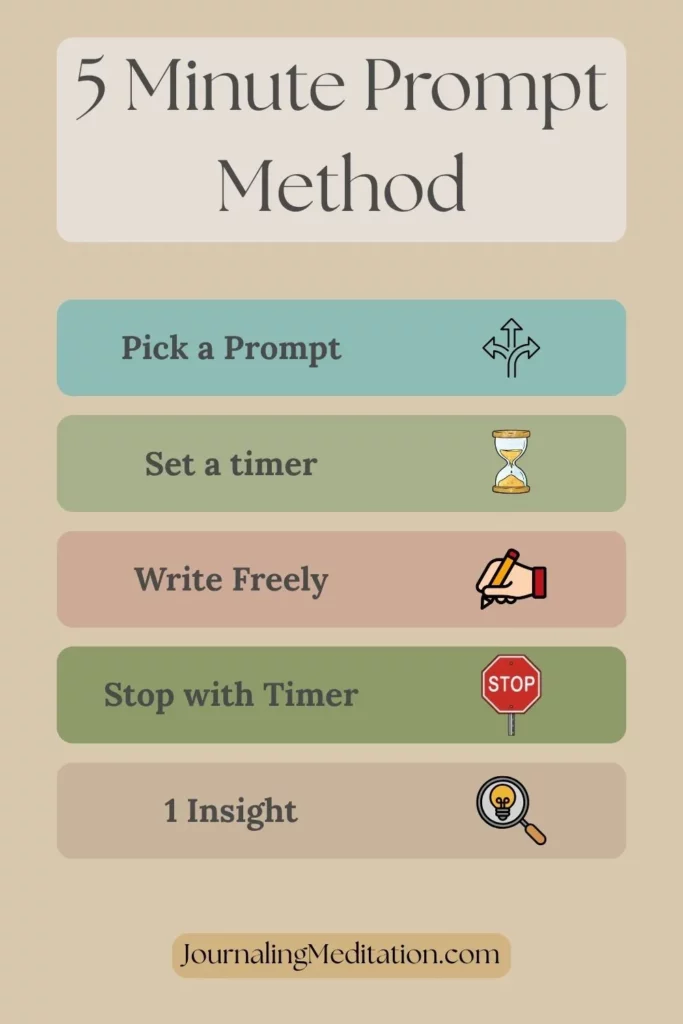
This is my go-to when motivation is low:
- Pick one prompt
- Set a 5-minute timer
- Write without stopping or editing
- Stop when the timer ends
- Highlight one insight
That’s it. No pressure to be anything more.
If you find yourself getting stuck choosing prompts, using a structured journal with prompts can help remove that obstacle. I’ve found that having prompts already laid out makes it much easier to stay consistent, especially on busy days.
👉 You can explore a few well-designed options here on Bookshop.org
Create a Ritual That Sticks
Consistency beats intensity and duration every time.
Try pairing journaling with:
- Morning coffee
- A short meditation
- Your evening wind-down routine
The goal is to make it automatic, not something you have to “decide” to do.
If consistency is where you struggle, these journaling tips for building a regular practice can help you make writing easier to stick with.
Common Mistakes to Avoid
- Treating prompts like homework
- Waiting for the “perfect mood”
- Overanalyzing what you wrote
Honestly, messy journaling is usually the most effective journaling.
Benefits of Using a Journal With Prompts
Let’s break this down in a way that makes sense.
Mental Clarity & Emotional Regulation
Writing helps organize your thoughts. Prompts take it even further by directing your attention to what matters.
Studies on expressive writing show reduced stress and improved mood over time.
Boosting Creativity in an AI World
Ironically, prompts can actually make you more original.
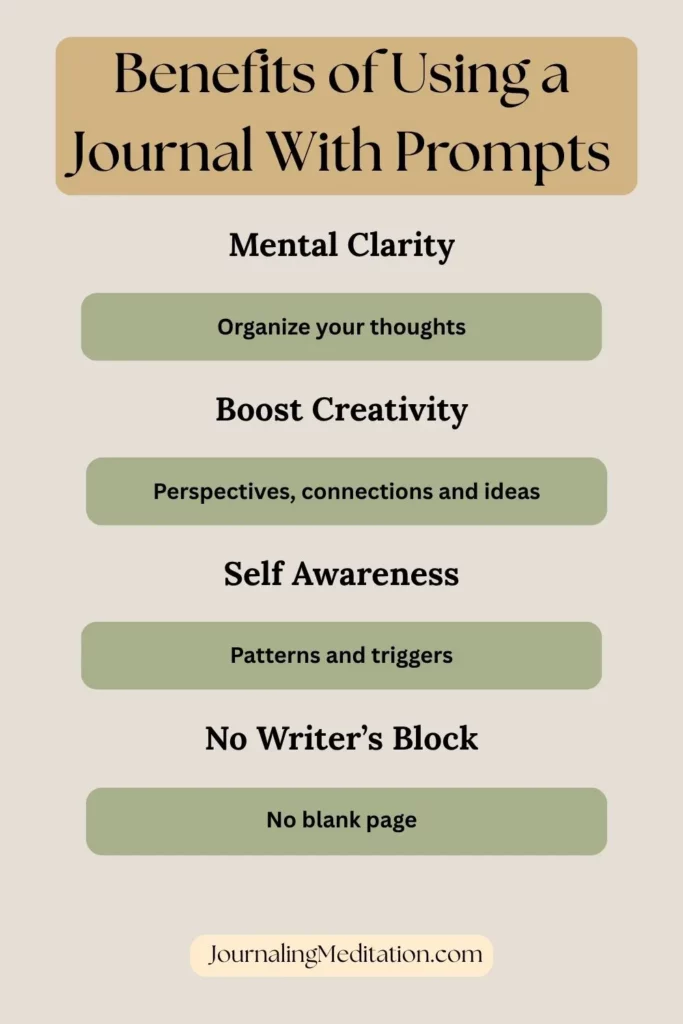
They push you to:
- Explore new perspectives
- Make unexpected connections
- Think beyond surface-level ideas
If that’s the side of journaling you enjoy most, creative journaling gives you even more freedom to experiment beyond traditional written entries.
Building Self-Awareness
Over time, patterns start to emerge:
- Repeated fears
- Recurring goals
- Emotional triggers
That awareness is where real growth begins.
That’s also why I like using a daily journal with prompts for self-discovery. The questions can help uncover patterns you might otherwise overlook.
Overcoming Writer’s Block Instantly
No more staring at a blank page.
Prompts give you an instant starting point.
This is also where a guided journal really shines. Instead of relying on motivation, you simply open to a page and start writing. That small shift can make the difference between journaling occasionally and actually building a habit.
👉 See prompt-based journals that are designed for consistency
How Long Should a Journal Prompt Be?
Short answer? It depends.
Short vs. Long Prompts
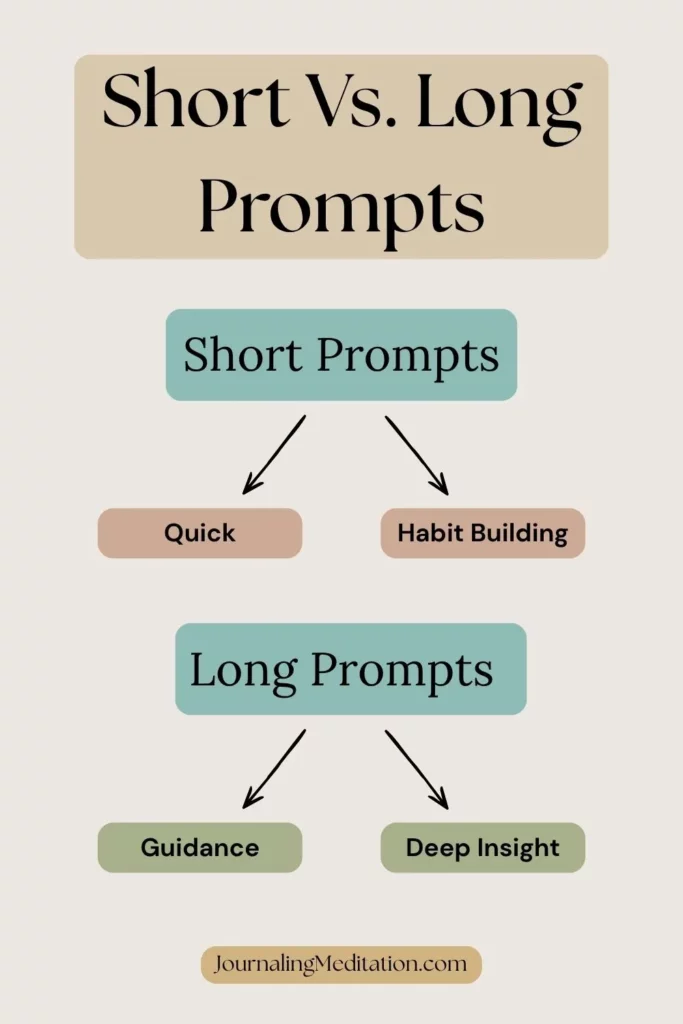
Short prompts:
- Quick and flexible
- Great for daily habits
Long prompts:
- More guidance
- Better for deep reflection and insightful sessions
Rule of Thumb
If a prompt makes you think immediately, it’s the right length.
25 Journal Prompts to Get You Started
Self-Discovery
- What do I value most right now?
- Who do I feel I am becoming?
- What drains my energy?
- What excites me lately?
- What am I avoiding?
Emotional Check-In
- What am I feeling today and why?
- What emotion keeps coming back?
- What do I need right now?
- What’s been weighing on me?
- What helped me feel better recently?
Growth & Goals
- What does progress look like this week?
- What’s one small win I can achieve today?
- Where am I playing small?
- What would I do if I wasn’t afraid?
- What habit (or lack of) would change everything?
Creativity Boost
- Describe your dream day
- Write a letter to your future self
- What would your life look like as a movie?
- If you could start over, what would you do?
- What ideas have you been ignoring?
Mindfulness & Gratitude
- What made me smile today?
- What am I grateful for right now?
- What did I notice today that I usually miss?
- What slowed me down today?
- What felt meaningful?
Want to keep going? These 15 journal prompts for adults explore goals, relationships, values, gratitude, fears, and other areas worth reflecting on.
Prompt Journaling + Meditation (My Favorite Combo)
This is where things get interesting.
How I Pair Them
- 5 minutes of deep breathing
- Notice thoughts without reacting
- Then write from a prechosen prompt
You’d be surprised how much clearer your responses become.
Simple Flow to Try
- Sit quietly
- Breathe slowly
- Observe thoughts
- What would today’s perfect day look like?
- Free write from that calm state
It turns journaling into something deeper than just “dumping your thoughts on paper.”
If you enjoy combining the two practices, try some of these meditation journal prompts to give that post-meditation reflection a little more direction.
Digital vs Paper Journals in 2026
Both work, it just depends on you.
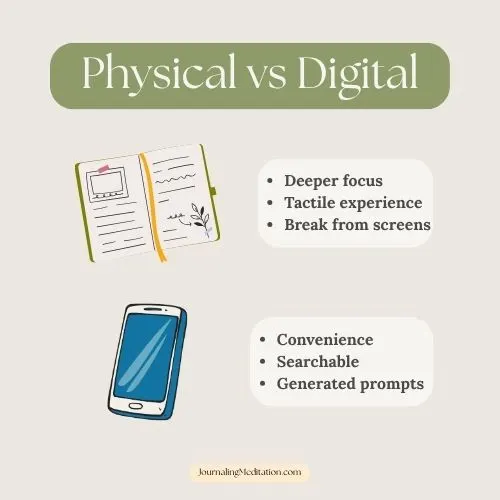
When to Use a Physical Journal
- You want deeper focus
- You enjoy the tactile experience
- You get a break from screens
When to Go Digital
- You want convenience
- You like searchable entries
- You can use AI-generated prompts
No wrong choice here. The most important thing is to find what you’ll actually use consistently.
Who Should Use a Journal With Prompts?
Honestly? Almost everyone.
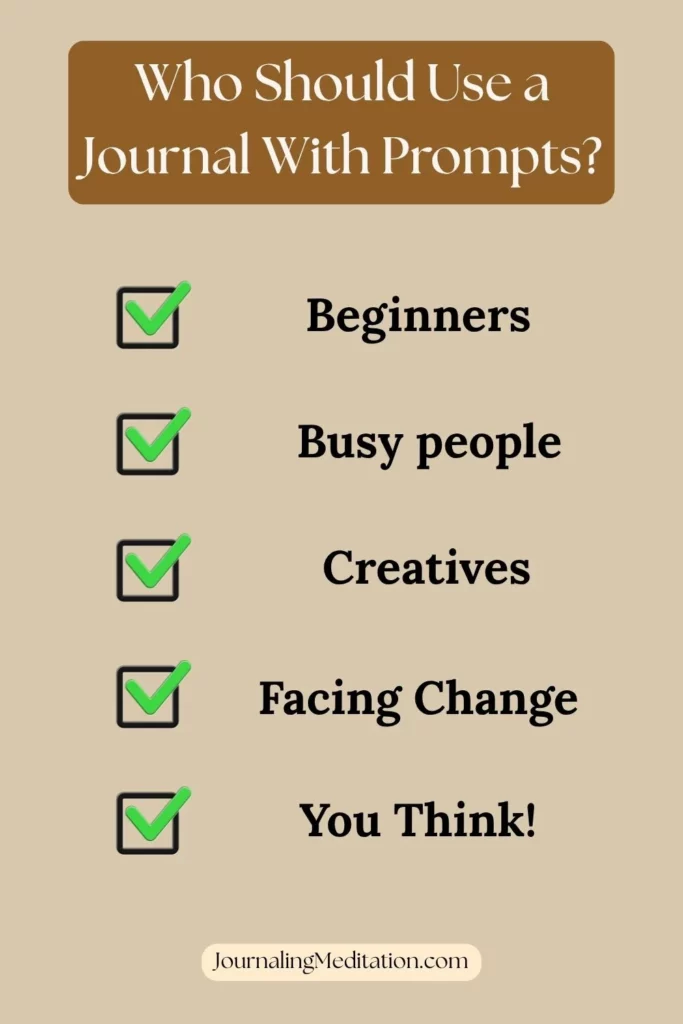
- Beginners learning how to start journaling
- Busy people who want a quick reflection
- Creatives looking for ideas
- Anyone going through change and uncertainty
If you have thoughts (and if you’re like ANYONE, you do), this works.
Choosing the Right Journal With Prompts (Quick Guide)
Not all prompt journals are created equal. Here’s how I usually think about it:
If you’re a beginner:
Look for journals with short, simple prompts that don’t feel overwhelming.
👉 Browse beginner-friendly prompt journals
If you want deeper self-reflection:
Choose journals with longer, more thought-provoking prompts.
👉 Explore deeper reflection journals
If you’re focused on mindfulness:
Go for journals that include breathing cues or gratitude prompts.
👉 Find mindfulness-based prompt journals
FAQs About Journaling With Prompts
What is a journal with prompts?
A journal with prompts generally includes guided questions or statements to help you write with direction instead of starting from scratch or coming up with your own entry.
Are journal prompts effective?
Yes, especially for consistency. Prompts take away the stress or not knowing what to write and help you start immediately, which is key to building the habit.
How often should I use journal prompts?
- Daily → best for habit building
- 2 – 3 times/week → works for reflection
- Occasionally → still helpful, but may leave you feeling scattered
Consistency matters more than frequency. Even if it’s only a minute or two, every day is optimal.
Can journaling improve mental health?
Research suggests it can:
- Reduce stress
- Improve emotional processing
- Increase self-awareness
It’s not a replacement for therapy, but it’s a powerful support tool.
Can I create my own prompts?
Absolutely. In fact, some of the best prompts come from your current struggles or questions.
Final Thoughts: Start Small, Stay Curious
A journal with prompts isn’t about writing perfectly. It’s about showing up honestly and consistently.
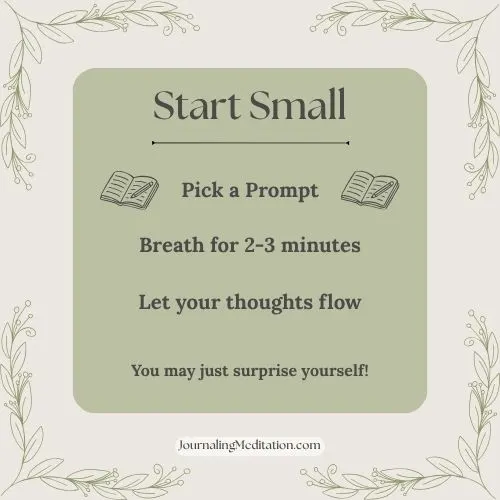
Start with one prompt.
Give it 2-3 minutes.
See what comes out.
You might be surprised by what’s been waiting to be heard.
If getting started has always been the hardest part, a simple journal with prompts might be exactly what you need to remove that barrier.
👉 Take a look at a few prompt journals here if you want an easy starting point
Now I’m curious. Do you prefer structured prompts or totally free journaling? Drop a comment and let’s compare notes.