Have you ever found yourself ruminating over the same conversation over and over in your head, long after the conversation ended?
Maybe you’re lying in bed wondering if you said something wrong. Maybe you’re stressing about a decision you need to make. Or maybe your mind is just jumping from one worry to another without giving you a moment of peace.
I’ve been there.
The frustrating thing about overthinking is that it often feels productive. We tell ourselves we’re working on a problem, but hours later we’re still stuck in the same mental loop. Only now we’re tired, stressed and probably worked up.
Fortunately, there are two little rituals that can help: journaling and meditation.
Journaling helps get your thoughts out of your head and onto paper. Meditation helps you step away from your thoughts and stop getting pulled into every thought that appears. Together, they can create a powerful daily habit for calming a busy mind.
TL;DR
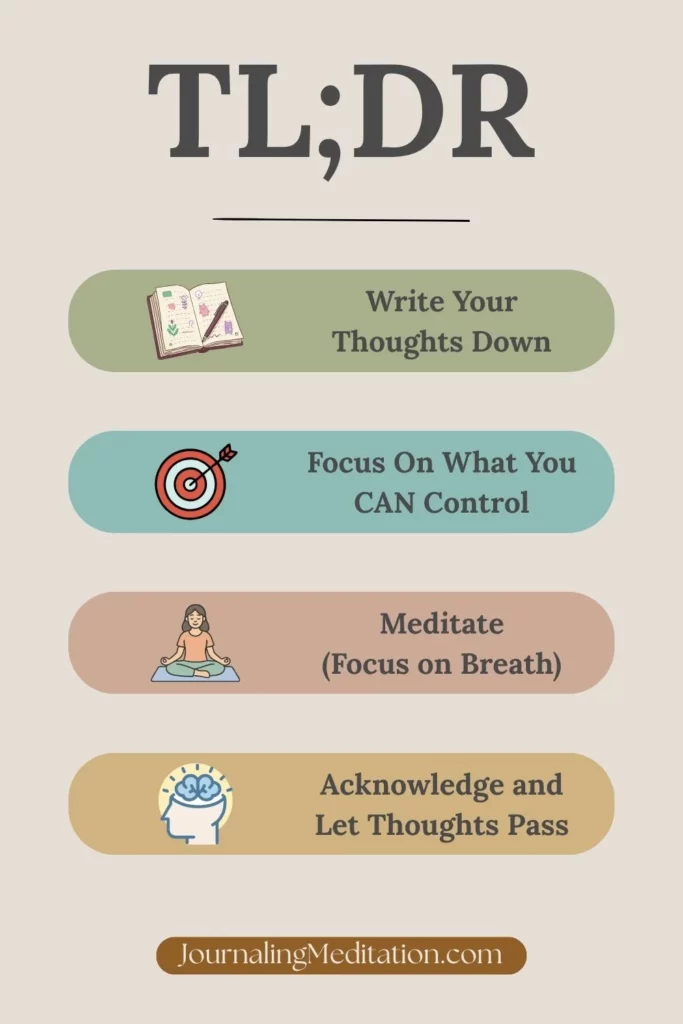
If overthinking is making you feel anxious, stressed, or leaves you mentally exhausted, try these:
- Write your thoughts down instead of carrying them botted up in your head.
- Try to focus on what you can control today.
- Spend a few minutes meditating (focus on your breath).
- Don’t try to stop your thoughts… notice them and try to let them pass.
A very basic 10-minute journaling and meditation routine can help quiet the noise of mental chatter and lighten the load for your day.
Why We Overthink
Most overthinking comes from good intentions.
Our brains are constantly trying to protect us from mistakes, embarrassment, failure, or uncertainty. The problem is that life rarely cares and returns with uncertainty.
When the mind can’t find a perfect answer, it often keeps looking.
That’s why you may find yourself replaying a conversation from yesterday or imagining every possible outcome of what can possibly happen.
Instead of helping, the thinking becomes a loop.
The more you think, the more anxious you feel.
The more anxious you feel, the more you think.
This is one reason overthinking and stress often seem to feed each other. When stress levels go up, it gets harder to let go of repetitive thoughts, and those thoughts can create even more stress. Learning healthy ways to reduce stress can make it much easier to break the cycle.
But how do you know when normal reflection has crossed the line into overthinking? Here are a few common signs.
Signs You’re Stuck in an Overthinking Loop
Sometimes overthinking becomes such a normal part of our day that we don’t even realize we’re doing it.
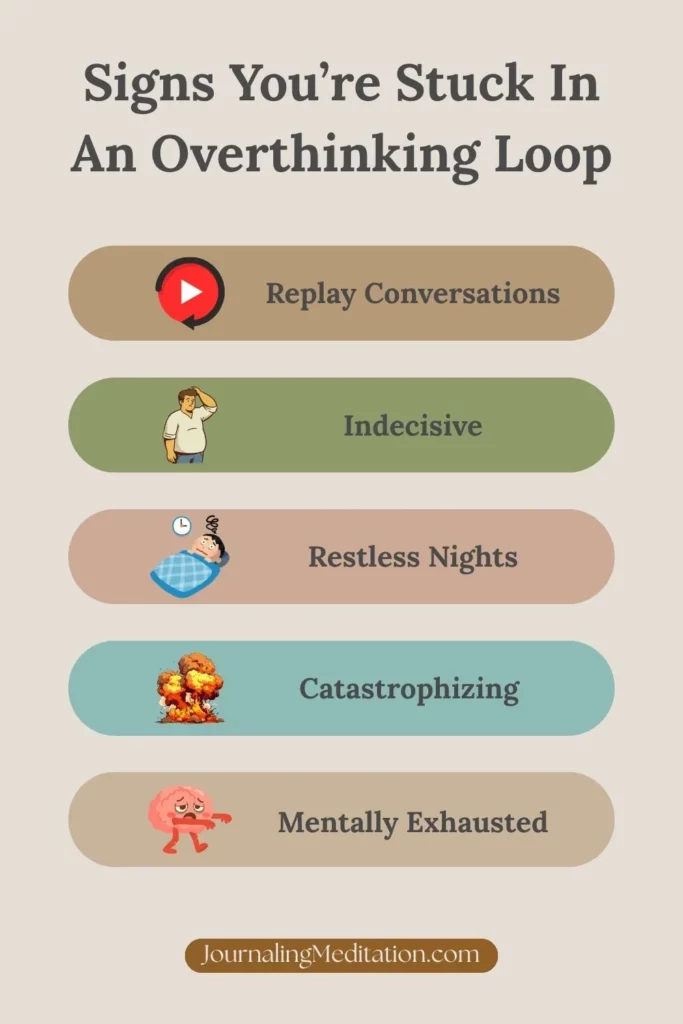
You may be caught in an overthinking loop if you find yourself:
- Replaying conversations long after they’ve ended
- Struggling to make even simple decisions
- Lying awake at night because your mind won’t slow down
- Constantly imagining worst-case scenarios
- Feeling mentally exhausted even when you’ve done very little physically
The tricky thing about overthinking is that it can disguise itself as problem-solving. It can feel like you’re making progress, when you’re really just running the same thoughts through your mind over and over again.
If several of these signs sound familiar, don’t worry. You’re not alone. The good news is that practices like journaling and meditation can help break the cycle and bring your attention back to the present moment.
One reason I encourage people to keep a journal for mental health is that it helps identify recurring thought patterns before they begin to spiral into chronic stress or anxiety.
How Journaling Helps Calm Racing Thoughts
One of the reasons I love journaling is that it gives me somewhere to separate from my thoughts.
When worries are in your head, they like to bounce around for attention. Writing them down creates a sense of relief because your brain is no longer holding onto everything at once.
Think of journaling as clearing off a cluttered desk.
Once everything is out in the open, it’s much easier to see what’s actually important.
Journaling can also help you separate facts from fears.Especially the irrational ones.
For example:
Fact: My friend hasn’t texted me back.
Fear: They’re upset with me.
Writing things down helps us see how much of our anxiety is based on assumptions rather than reality.

Even a simple five-minute brain dump can make a huge difference when your thoughts feel overwhelming.
How Meditation Helps You Stop Following Every Thought
Most people don’t even try meditation because they believe they’re supposed to stop thinking completely.
That’s not how meditation works.
Even people that have been meditating for years have thoughts.
The trick is that meditation teaches you not to get sucked in by every thought that appears.
Imagine sitting beside a road and watching cars (thoughts) drive by.
Some cars are interesting.
Some are noisy.
Some are completely pointless.
Meditation helps you watch them pass instead of jumping into each one that passes by and letting it take you somewhere you never intended to go.
The more you practice, the easier it becomes to recognize when you’re overthinking. And the better your awareness helps gently return your attention to the present moment.
If you’re new to meditation, don’t worry about doing it perfectly. Most beginners struggle with wandering thoughts and distractions at first. That’s completely normal and part of the learning process. My guide to meditation for beginners walks through a simple approach to getting started without overcomplicating it.
My Simple 10-Minute Routine for Overthinking
Whenever I notice myself getting stuck in a mental loop, I stop and break out this:
Step 1: Brain Dump for 5 Minutes

Open your journal and write whatever is on your mind.
Don’t worry about grammar, structure, or making sense.
Just write.
If you’re not sure where to start, try answering these questions:
- What am I worried about right now?
- What keeps replaying in my mind?
- What is within my control today?
- What is one small action I can take?
Once you’ve written everything down, close the journal.
You’re not here to solve the problem immediately.
Step 2: Breathe for 5 Minutes
Sit comfortably and focus on your breathing.
Notice the feeling of each inhale and exhale.
When your mind wanders, gently bring your attention back to your breath.
No blame.
No frustration.
Just return to the breath.
The goal isn’t a perfectly quiet mind.That’s impossible
The goal is learning not to follow every thought that appears.
5 Journal Prompts for Overthinking
If you’re struggling to get started, follow these prompts:
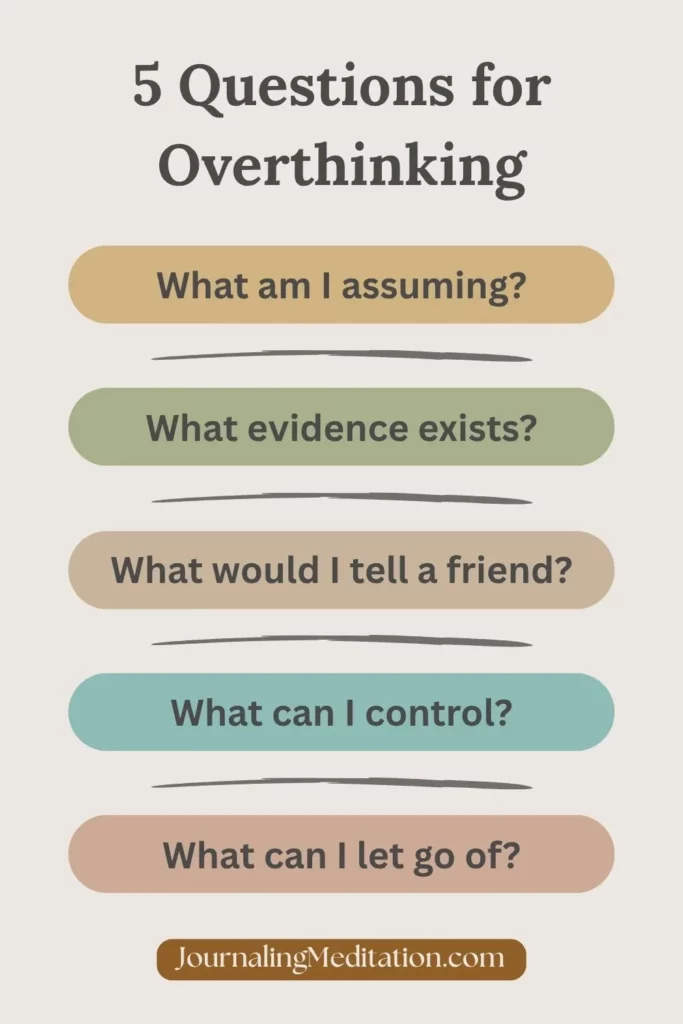
1. What am I assuming is true right now?
2. What evidence supports this worry?
3. What would I tell a friend in this situation?
4. What is actually within my control right now?
5. What can I let go of before bed?
These questions can help you shift your focus away from what may just be fear back to curiosity.
Frequently Asked Questions
Is overthinking a sign of anxiety?
Not always. Everyone overthinks from time to time, especially during stressful situations or when facing uncertainty. However, frequent overthinking can sometimes be connected to anxiety, stress, or worry. If overthinking is affecting your sleep, relationships, or daily life, it may be worth speaking with a mental health professional.
Can journaling really help with overthinking?
Many people find that journaling helps reduce overthinking because it gets thoughts out of their head and onto paper. Writing can provide clarity, help identify patterns, and make it easier to separate facts from fears.
What type of journaling is best for overthinking?
There isn’t a single “best” method. A simple brain dump is often one of the easiest ways to start. You can also use journal prompts, gratitude journaling, or reflective journaling to better understand your thoughts and emotions.
How long should I meditate to stop overthinking?
You don’t need to meditate for an hour to see benefits. Even five to ten minutes of focused breathing or mindfulness practice can help you become more aware of your thoughts and reduce the urge to follow every mental distraction.
Can meditation stop intrusive thoughts?
Meditation doesn’t eliminate intrusive thoughts, but it can change how you respond to them. Instead of becoming caught up in every thought, meditation teaches you to observe them without judgment and gently return your attention to the present moment.
Final Thoughts
Overthinking doesn’t mean there’s something wrong with you.
It is usually an indication that your mind is working overtime trying to protect you.
The challenge is that too much thinking rarely brings peace. In most cases, it only brings about more stress.
That’s why I find journaling and meditation such a strong and useful combination.
Journaling helps empty the mental clutter.
Meditation helps you stop getting caught up in every thought.
Together, they create a place for something many of us need more of: calm.
The next time you catch yourself stuck worrying about something over and over, grab a journal, spend a few minutes writing, and then sit quietly with your breath.
Ten minutes might be all it takes to start seeing things a little more clearly.
Do you struggle with overthinking? Have you tried journaling or meditation and if so, has it helped you quiet your mind? Let me know in the comments below!