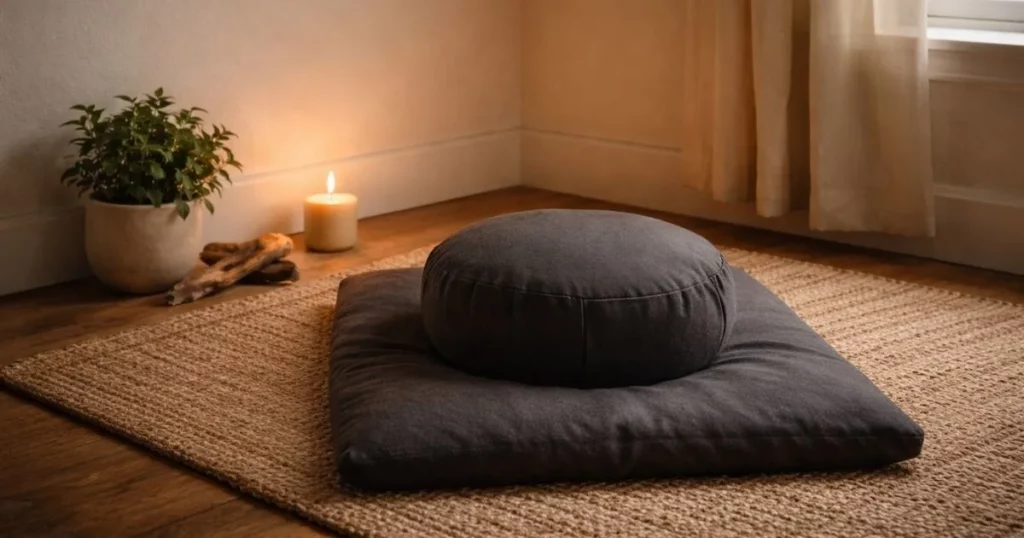
Here’s something most meditation guides don’t tell you: the hardest part of meditating isn’t the actual practice. It’s sitting down in the first place.
Your environment is either making that easier or harder every single day. A cluttered corner near your work desk, a chair facing a bright window, a room where your phone is always right next to you; these things quietly raise the obstacles to a regular practice. And over time, the obstacles win.

A dedicated meditation space changes this. It tells your nervous system — through sensory cues it recognizes before you’ve taken a single conscious breath — that this is a place for stillness. The space begins the work before you do.
Whether you have a spare room or just a corner of your bedroom, what follows will help you build something that actually holds your practice.
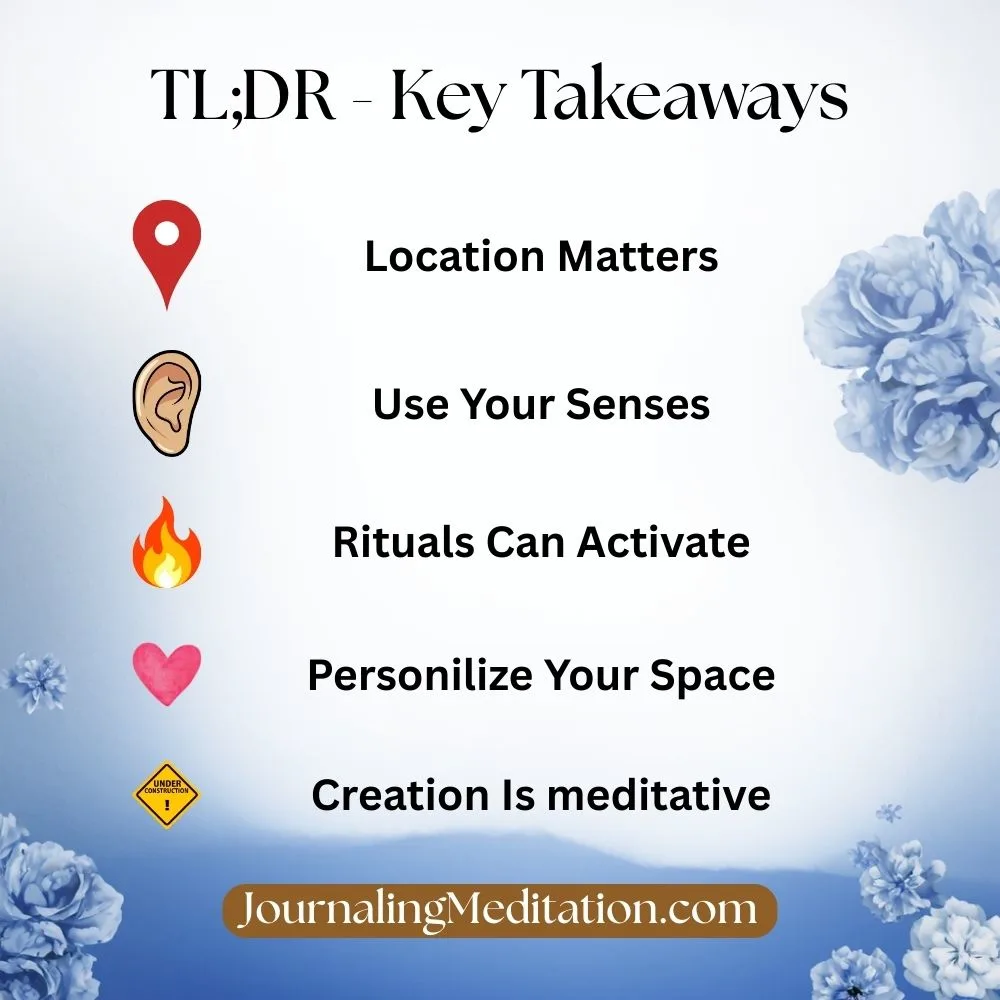
TL;DR — Key Takeaways
- Location matters more than size: Even a small corner can become a powerful meditation space with the right setup.
- Your senses are your tools: Sound, scent, lighting, and touch all signal your nervous system to shift into a calm state.
- Ritual activates the space: The physical environment and your daily practice rituals must work together for lasting results.
- Personalization beats perfection: A meaningful, consistent space outperforms a beautiful one you never use.
- Creating a calming meditation space is itself a meditative act: The process builds the practice.
Why Your Space Matters More Than You Think
Creating a calming meditation space removes the friction and tells your brain, through sensory cues it recognizes before you’ve taken a single breath, that this is a place for stillness. The space can actually do some of the work for you.
Whether you have a spare room or just a corner of your bedroom, this article will help you build something that actually works.
The 10 Tips
1. Choose Your Location Intentionally
Most people pick their meditation spot by default, like whatever space is available, closest, or least inconvenient. This is the first mistake.
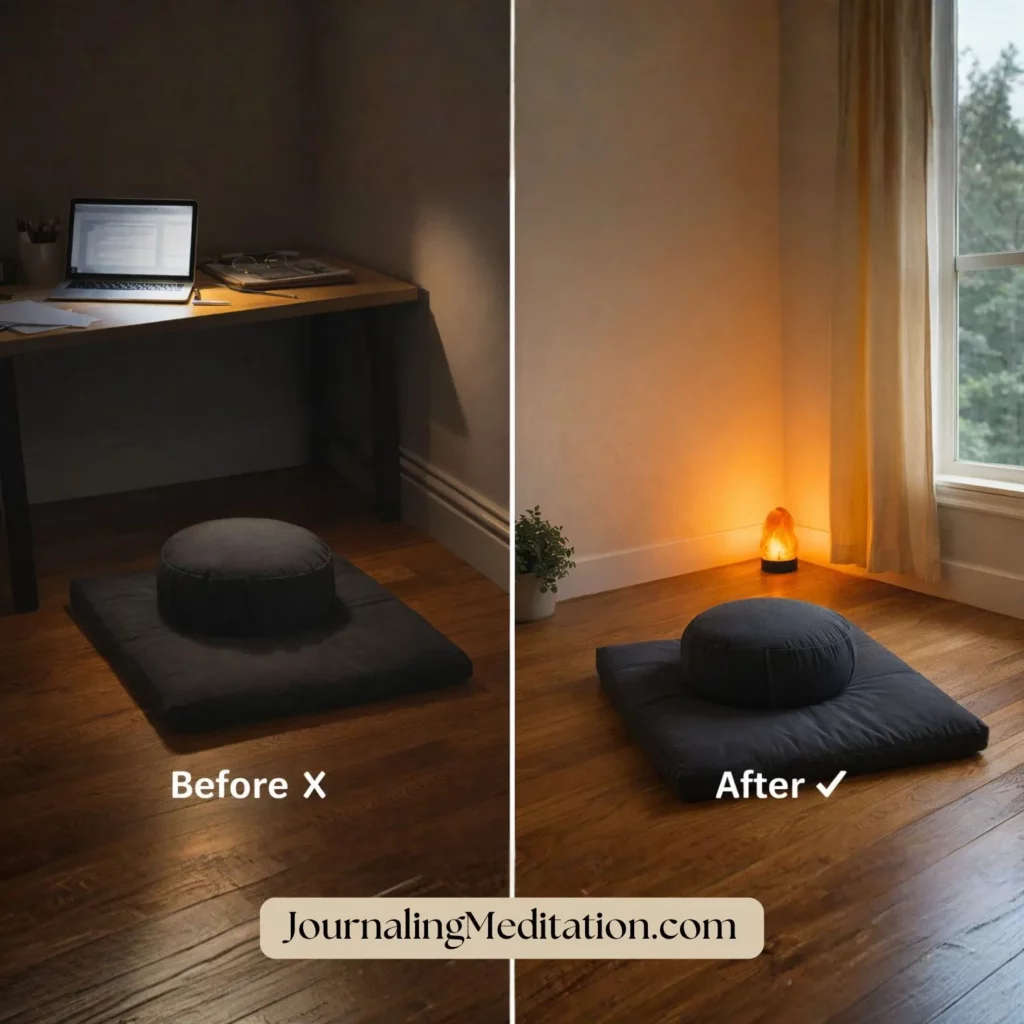
When scouting your space, ask one question: “Does this separate me from the busyness of my day?” It doesn’t need to be a separate room. A corner with its back to the rest of the house, a nook beside a window, or even a spot on a balcony can all qualify. What matters is that you use it only for meditation. Because consistency of location is what transforms a spot into a sanctuary.
2. Clear the Space (This Is Already the Practice)
Before you add anything to your meditation space, take things away.
You don’t need to become a minimalist. You just need this space to feel clear.
Use a small rug or a folding screen to define the boundaries of your area within a larger room. Keep surfaces simple. And if possible, remove phone/tablets completely. Clearing the space before you sit isn’t just preparation. It’s the beginning of the practice itself, a ritual that starts shifting your state before you’ve even closed your eyes.
3. Get the Lighting Right
Overhead fluorescent lighting is the enemy of calm.
Aim for bulbs in the 2700K–3000K color temperature range, ideally dimmable. A salt lamp in the corner, a few pillar candles, or a single warm-toned floor lamp are all excellent choices. If you meditate near a window, position yourself so the light falls to your side rather than directly into your eyes.
Think of lighting as a dial, not a switch. The lower and warmer your light, the more your environment is doing the work of relaxation before the session even begins.
4. Design Your Sound Environment
Silence is the goal for many meditators, but it isn’t always the case or available. And for beginners especially, complete quiet can actually increase mental restlessness. When there’s nothing to hear, the mind tends to fills the space aggressively.
Try using sound intentionally. Brown noise or pink noise can help mask ambient disturbance. Nature soundscapes like rainfall, forest ambience, flowing water all have positive effects and are worth experimenting with before just settling with silence.
The more advanced technique here is developing an audio anchor: a specific sound used exclusively during your sessions. Over weeks of regular use, that sound alone begins to help cue a faster shift into meditative states. You hear it, and something in you settles. That’s not magic. It’s conditioning, and it’s one of the most efficient tools available.
18 Must-Have Meditation Tools
5. Choose a Calming Color Palette
You don’t need to repaint your walls, but color is worth thinking about.
Cool, neutral tones have measurable effects on stress. Soft blues, sage greens, warm whites, and muted earth tones all tend to lower excitement. Bright reds, sharp yellows, and high-contrast combinations do the opposite, triggering the brain’s attention, whether you notice it or not.
The good news is that blankets and pillows do a lot of “heavy” lifting here. A sage-colored throw over a bright chair, a cream-colored meditation cushion, candles on a wooden surface… together these shift what designers call the “visual temperature” of a space. Even in a room with strong walls or patterned furniture, soft and natural-toned objects can meaningfully change how settled the space feels.
6. Prioritize Comfort in Your Seating
Many believe that meditating on the floor is somehow more “correct” than sitting in a chair. It isn’t.
Discomfort is one of the most common reasons people end up quitting. If your hips ache after five minutes, your brain is not going to associate that cushion with peace. It’s going to associate it with torture.
Find what supports your body. A zafu cushion works beautifully for flexible sitters. A seiza bench solves knee issues by creating a kneeling posture. A straight-backed chair with feet flat on the floor is another possible means. What you’re looking for is a position where your spine is supported, your breathing is unrestricted, and you can stay for twenty minutes without shifting.
Your body is part of your meditation space too.
7. Bring Nature Into the Space
Biophilic design, or the integration of natural elements into built environments, is one of the most well-researched approaches to reducing stress. The principle is straightforward: humans evolved in natural environments, and our nervous systems still respond to natural elements in turn.
You don’t need a garden. Small additions can shift the quality of a space significantly.
A single low-maintenance plant like a snake plant or peace lily introduces organic life and even soft air-filtering benefits. Natural materials like wood, stone, linen, clay add a grounding quality that can’t be replaced. A small tabletop water fountain brings in the sound of flowing water, which has a uniquely strong calming effect.
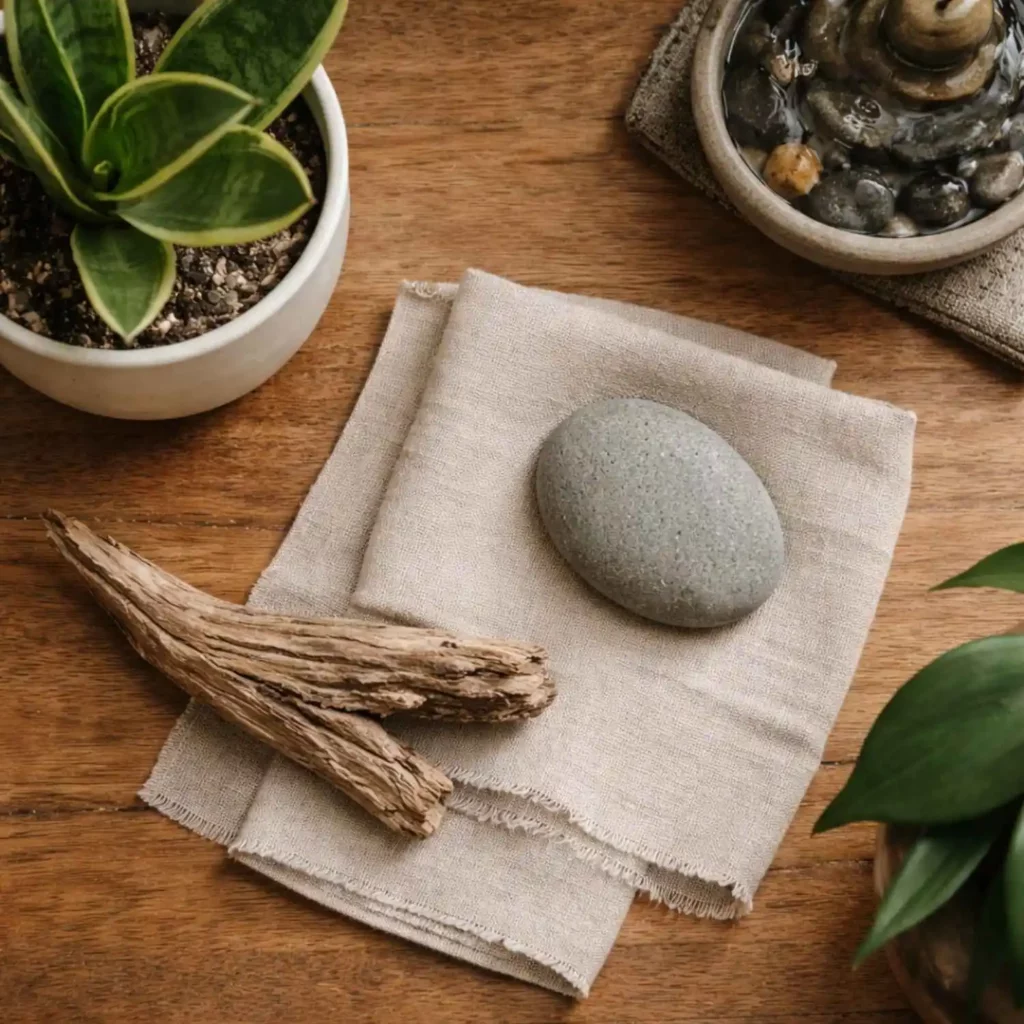
Plants, natural texture, grounding items and the space already feels more alive and more still at the same time.
8. Use Scent as a Conditioning Tool
Of all the sensory tools available for creating a calming meditation space, scent is the most underused. And it may be the most powerful.
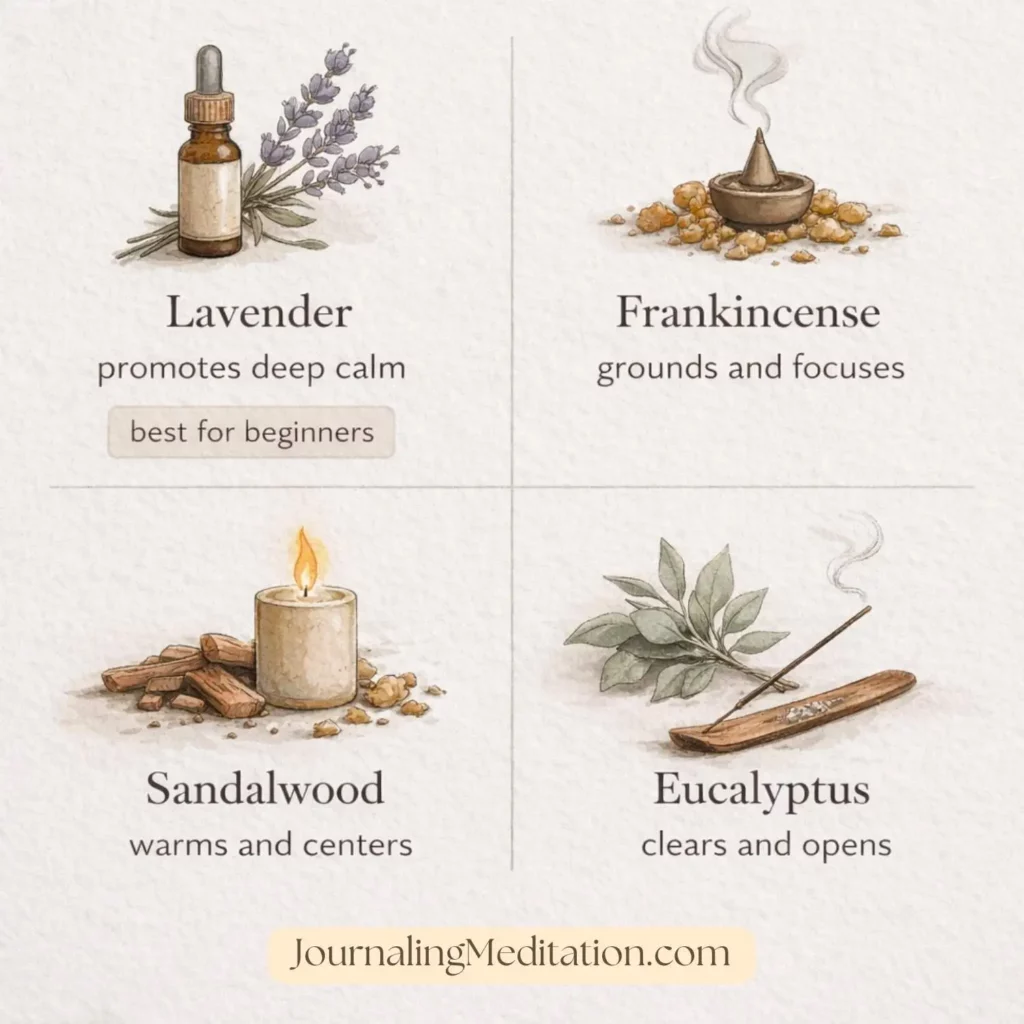
The olfactory system connects directly to the limbic system, the brain’s emotional core, bypassing the analytical thinking brain entirely. Scent triggers physiological responses faster than any other sense. Lavender, frankincense, sandalwood, and eucalyptus all have powerful calming effects and are widely available as essential oils, incense, or diffuser blends.
Here’s your opportunity for using scent as a conditioning tool. Use the exact same scent every single time you meditate, and your brain begins to associate it with the meditation itself. After weeks of regular practice, simply lighting that incense or diffusing that oil will begin to lower your heart rate and soften mental noise before you’ve made any effort.
That’s olfactory conditioning, and it works whether or not you’re aware it’s happening.
9. Personalize With a Few Meaningful Objects
A meditation space should feel personal. Not decorated, but personal.
The objects you choose act as intention cues, physical anchors that quietly remind your mind why you’re there. A mala bead strand, a smooth stone, a small singing bowl, and a piece of art that encourages stillness aren’t decorations. They’re psychological tools. Each one is a small, silent reminder of your commitment to the practice.
The key distinction is between objects that create meaning and objects that create emotional noise. A photograph that triggers nostalgia or unresolved feeling pulls your attention in the wrong direction, even if you love it. Choose objects that quiet the mind and keep the space minimal. One to three meaningful objects, chosen with care, will always outperform a crowded altar over time.
5 Simple Zen Meditation Room Ideas
10. Build Rituals That Activate the Space
Here is the tip that most miss entirely: the space alone is not enough.
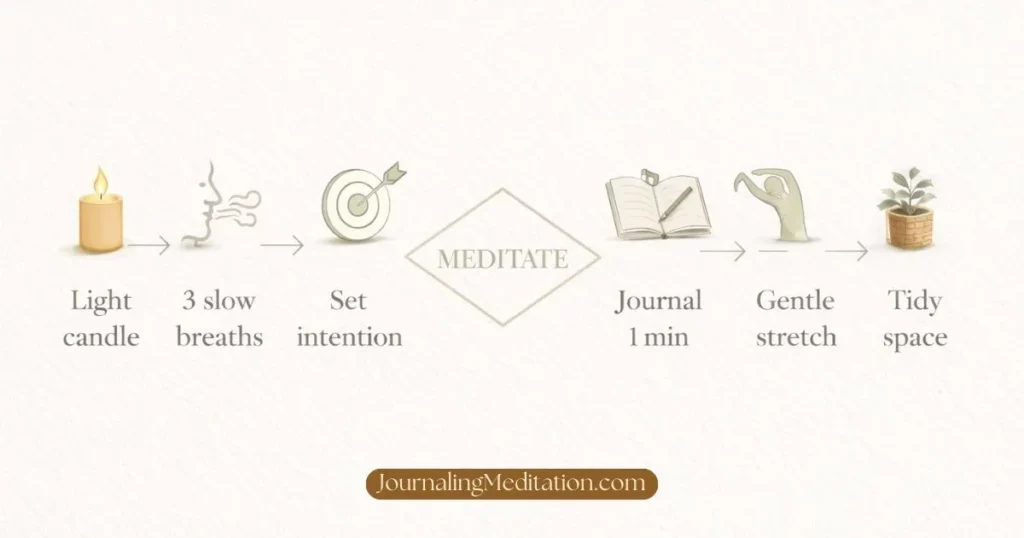
Rituals are the on-ramp. A consistent pre-meditation sequence such as lighting a candle, taking three slow conscious breaths, or setting a single intention for the session helps train your brain to associate that sequence with what follows. Over time, the ritual becomes a trigger, and the shift into stillness happens faster and more reliably than any technique alone can produce.
Post-meditation rituals are just as important. A minute of journaling, a few gentle stretches, or simply tidying the space before you leave acts as a closing practice. Even a simple “thank you” can create closure for the practice.
The space and the ritual are partners. Neither works as well without the other.
A Few Mistakes Worth Avoiding
The most common pitfall is making the space too special to use daily. If sitting down feels like a formal occasion, that friction builds and consistency will suffer. Keep the bar. The space should feel comfortable, not performative.
Other common errors: choosing location by convenience rather than calming potential, ignoring the acoustic environment entirely, and over-decorating until the space feels more like a display than a practice. The principle throughout is simple: every element should serve the practice. If it doesn’t, it doesn’t need to be there.
Frequently Asked Questions
Creating a calming meditation space raises questions regardless of experience level. Here are clear, direct answers to the ones that come up most often.
📏 How much space do I actually need?
Surprisingly little. A 3×3 foot area, enough for a cushion or chair and a small surface, should be enough. What matters isn’t the size but the consistency of use. A small, clearly defined corner used daily will outperform a large, uncommitted room every time.
🧘 Can I use the same space for yoga and meditation?
Yes, but keep the sensory signals distinct. Use different lighting levels or different scents for each practice so your brain can clearly differentiate between movement mode and stillness mode. Practice overlap is fine but sensory overlap undermines the conditioning benefit you’re trying to build.
⏳ How long before a dedicated space actually makes a difference?
Most practitioners notice a change within two to three weeks of consistent daily use. You’ll begin to feel a subtle state shift simply from entering the space, before you’ve consciously settled. The longer and more consistently you use it, the stronger that effect becomes.
Over to You
Here’s a question worth sitting with: What is the single biggest obstacle between you and a consistent meditation practice right now and does your current space address it?
Leave your answer in the comments. Whether you’re working with a spare bedroom or a two-foot corner of a studio apartment, every setup is different. And real experience from this community is some of the most useful guidance there is.